Breguet Celebrates 250 Years with a Tribute to a Watch from 1797 (w/ Hands-On Photos)
If you’re into watches, then you’re into Abraham-Louis Breguet. One of the founders of modern horology, his innovations set the course of the industry and remain relevant. Whether that’s in terms of his inventions like the tourbillon, the gong-spring, his signature overcoil, self-winding, or shock protection, to name but a few, or in marketing and selling his timepieces, his contributions set many standards. Of these listed, however, marketing and selling seem the least interesting, and yet, Breguet’s “Souscription” model and the watches created as a result, have served as inspiration for several of the modern Breguet brand’s most iconic timepieces. In 2005, the brand launched the Tradition line, bringing escapements to the dial of a wristwatch, and now, the Classique Souscription 2025, celebrating the company’s 250th anniversary.
The Souscription concept is one we are all very familiar with, if a slightly different take that suited the times. Upon ordering one of Breguet’s Souscription pieces, a quarter of the total price was paid to cover the parts. A deposit, if you will. The watch was made, and the remaining three-quarters were sent to acquire it. Sounds familiar, though typically we don’t fund the making of individual watches (though sometimes we do). A highly successful campaign that was advertised via a pamphlet, another innovation, it is said that around 700 watches were produced using this model.

The concept wasn’t just a method of payment, but a plan to attract a larger customer base by way of a more affordable watch. As such, the Souscription timepieces are amongst Breguet’s most straightforward. Within a large 61mm case of gold or silver, time was told via a single, large hour hand. Though there are many examples, the most basic (and the first sold, apparently) featured white enamel dials with Breguet numerals and a ladder index with clever markings for reading 5-minute intervals with accuracy. Breguet’s “secret signature,” a method of preventing forgeries, can also be found.
The movement featured a gorgeous symmetrical design with a single large barrel for a 36-hour power reserve at center held by a large bridge. Smaller triangular finger bridges flank either side, one holding the balance, the other the second wheel. The balance is particularly striking as its design is so similar to what we see in our watches today, with the cylindrical balance wheel, flat spring, “parachute” shock absorber, and indexed regulator. For a detailed look and breakdown of an original Breguet Souscription watch that includes great photos of the incredibly intricate, hand made components, check out this breakdown by The Naked Watchmaker, I highly recommend it.

© The Trustees of the British Museum. Shared under a Creative Commons Attribution-NonCommercial-ShareAlike 4.0 International (CC BY-NC-SA 4.0) licence.
As mentioned before, in 2005, Breguet, which joined the Swatch Group in 1999, launched the Tradition 7027, providing a needed jolt into the limelight. A remarkable watch, it distilled the aesthetic of Breguet’s pocket watch movements into a wearable, 37mm case and, most importantly, brought the escapement to the dial. Said to be inspired by the Souscription watches, the layout of the dial side clearly resembles the symmetrical calibers described above. However, the inclusion of a small, offset dial with hours and minutes, makes them more closely resemble Breguet’s “tact watches,” which had a similar feature, but on the dial side, rather than turning a single hand above a dial surface, it turned a pointer on the exterior of the case, allowing for reading only through touch. But that’s a digression for another day.

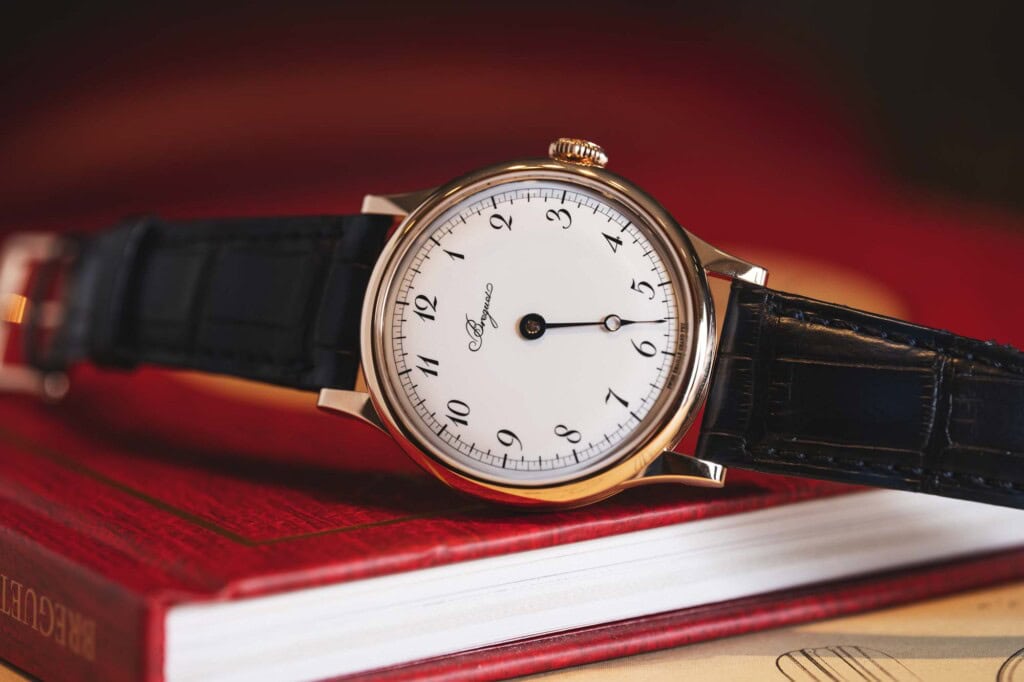
Twenty years later, and 250 years since the brand’s inception, Breguet is launching the Classique Souscription 2025, a new take on this concept that includes a few surprising features. Where the Tradition line perhaps mixed inspirations, the Classique Souscription is clear in its intentions with a white enamel dial and a single hand for telling the time. Closely mimicking the watch described earlier, the dial features supremely elegant Breguet numerals in black, a black index with markings for increments of five minutes, and a secret signature located above six, reading “Souscription / No X / Breguet”. The single-hand is thermally blued steel and features a shape that is a riff on the more standard “Breguet hand,” and is historically accurate as well.
Flip the watch over and you’ll find the VS00 caliber, which, no surprises, looks like that of the Souscription watches with its distinctive symmetrical design, central barrel, and three prominent bridges. It’s a manually wound caliber with a 96-hour power reserve, 21-jewels, 144 components in total, a Nivachron balance-spring with Bregeut overcoil, and a frequency of 21,600 bph. Made of brass, the movement is gilded to match the case and decorated with a fine media blasting for even surfaces, anglage on the bridges, and heat blue screw. There is also hand engraving on the main plate reading “Breguet No X,” where X is the specific number of the watch, as well as finer engraving of Breguet’s writing from the original Souscription pamphlet, on the ratchet wheel. Needless to say, it’s gorgeous. It is unclear if the VS00 is based on the 5XX calibers from the Tradition line, though they clearly share a similar architecture and design.


With the dial and movement pulling closely from the historical models, the case departs in a surprising and, I’m sure, controversial manner. The Breguet Classique line typically features a round case design, with some cushion designs appearing in the 1990s, characterized by straight lugs, scrolled ends, fluted case sides, and front and back bezels with small lips. Additionally, they use single-sided screw bars for attaching straps. The idea, obviously, was to resemble the pocket watches that inspired them. This design appears to date back to at least the 1960s, with the Bregeut Empire models.
The Classique Souscription departs from this mold with a new 40mm design featuring a more contemporary overall look, crafted from a new proprietary gold. Starting with the design, the soldered straight lugs are gone, as is the fluted mid-case; instead, the construction is more typical of modern wristwatches, featuring a three-piece assembly (back, mid-case, bezel) and tapering lugs. The lugs still feature a scroll form at their ends, but the screw-bars are gone, replaced instead with standard spring bars. Instead of fluting, the case side has been satin-brushed, whereas the other surfaces are polished. The case back features a large display window, along with various markings and hallmarks. There is also an engine-turned pattern along the back in a bespoke pattern called “Quai de l’Horloge,” named for the street in Paris where Breguet’s workshop was based.

The design is a surprising change, and I am unsure how it will be met. Purely objectively, it’s elegant if a bit plain in comparison. At 10.8mm thick with domed crystals on both sides, it should wear nicely. 40mm sounds a bit large in diameter, though the original Souscriptions were very large, partially for increased legibility of the single hand, so there is a logic there. The brand has also progressively upsized over the years, moving the Traditions from 37mm – 40mm as well, amongst other models.
The design is also softer, visually and literally, and, frankly, less stuffy (I say this as a Tradition owner), which could likely have broader appeal. With that said, it deviates from the pocket watch inspiration, particularly in its lack of fluted sides. Breguet’s pocket watches were textured on the sides for a better grip. One doesn’t need to hold a wristwatch in the same way, obviously, but as a visual feature, it was distinct. That said, Breguet points out that the Souscription watch this new model is based on didn’t have fluted sides, specifically. Ultimately, it appears less ornate and decadent, adopting a 20th-century dress watch style.

Finally, we arrive at the material: Breguet gold. An alloy of 75% gold, mixed with silver, copper, and palladium, the brand states that the pinkish color more closely resembles that of the gold used in the era of Breguet. Additionally, like most modern gold alloys, it should resist tarnishing.
I had the opportunity to see the Classique Souscription in person at the NYC boutique and, unsurprisingly, it was gorgeous. The packaging and presentation set you up for an experience. The new red leather box, with its curious pillow shape and golden accents, is nested within larger boxes, one of which contains a book on the Souscription watches. The watch, though 40mm, comes off as compact and wonderfully solid. The dial is immaculate with a perfectly white expanse that has just a hint of warmth and a subtle dome. The printing is perfect, which is particularly appreciable on the hair-thin script and calligraphic numerals. The secret signature is inscribed using a pantograph, as it would have been in Breguet’s time, and is truly a hidden detail (which, sadly, I found impossible to photograph).


Flipping it over, the movement, with its classical architecture, stuns. The existence of the Tradition line slightly diminishes the novelty of the design, but seeing it in this context has a different effect. The Tradition wears its novelty on its face, literally. The Souscription feels more like a watch powered by a historical movement, and as it’s hidden when on the wrist, more of a feature just for the wearer. The simplicity of the one-hand dial furthers this. The new “shot-last” decoration of the movement is excellent, like the Tradition’s, but with a different luster.
The case, while certainly a departure from what I expect from a Breguet, was appealing and worked well with the watch, if, as said, it’s less unique overall. The bezel and crystal are more curvaceous, which complements the domed dial well. The case sides, however, are quite flat, and as they are just brushed, they contribute less to the overall appearance. A gentle radius would have been appealing, though that would have affected how the lugs integrate.

Regardless, it wore well and came off as smaller than my 38mm Tradition 7037, as the dial is more compact and the shape is less harsh. It’s also more ergonomic in general. The new gold also looks very nice. It’s a pale pink hue that’s more understated than traditional yellow or rose tones. They paired it with a blue alligator strap that looks great with the enamel and gold combination.
I’m curious if this is a one-off use of this case design or the debut of a new style. I somehow doubt they will be replacing the Classique as we know it, but as a contemporary sub-line, it has some legs. Like the Tradition, which has variations spanning from two-hands with a power reserve to a constant-force tourbillon with fusee-and-chain, I can see this new style expanding, using the VS00 movement as a base. A two-handed model would be welcome, but Breguet’s archive is abundant with unique layouts and complications, so there are numerous opportunities. Then, perhaps, they can return the original Classique design to its 36mm roots, which would also be welcome, and better suits that case style.

The Classique Souscription 2025 is an interesting way for the brand to celebrate its 250th anniversary. Certainly, reviving an iconic design, movement included (spiritually, if not actually), is always a good approach, but focusing on something as simple as this is a statement in itself. The brand is known for its high and grande complications, and something that Bregeut pioneered was the phenomenon of resonance in watchmaking, which the modern company hasn’t reattempted. While that’s a specific example, grand gestures often accompany such momentous anniversaries. Admittedly, the year is still young, so maybe there are more surprises ahead.
The Classique Souscription 2025 is not limited, and the price is only available upon request. Breguet
The post Breguet Celebrates 250 Years with a Tribute to a Watch from 1797 (w/ Hands-On Photos) appeared first on Worn & Wound.


Comments
Post a Comment