Craft, Precision, and the Future of American Watchmaking: an Interview with Josh Shapiro

To pursue the level of watchmaking American independent brand J.N. Shapiro has, you need more than a bit of talent and a dash of ambition. Even if you manage to master the skills required to craft the impressively detailed neo-vintage watches J.N. Shapiro makes, having a unique enough take on a traditional aesthetic and the business savvy to compete on the world’s stage of independent watchmaking is another story altogether. It demands a near-monastic lifestyle to pull off.
J.N. Shapiro’s founder and visionary, Josh Shapiro, hasn’t just answered the call – he’s actually making it work.
More remarkable still, Shapiro produces his premier line of watches, the Resurgence, entirely in the United States and almost entirely in-house. Notably, “in-house” is used in the literal sense here, meaning under one roof – a very different thing from what that term has come to mean as a shadowy marketing tool that tends to gloss over some subcontracting and outside manufacturing. Every component in the Resurgence, save for jewels and springs, is entirely produced and finished by Shapiro and his team in California.
While a watch of the Resurgence’s caliber being produced both in-house and domestically is as impressive as it is unexpected, there’s more at play here than just an inflated sense of national pride. Bootstrapping high-level American watchmaking and parts manufacturing certainly benefits Shapiro’s operation first and foremost, but it’s also part of a larger, somewhat benevolent mission to reinvigorate the long dormant American watch manufacturing machine.
As a watchmaker, Shapiro’s calling card is his dial work. Prior to launching his own line, Shapiro made traditional engine-turned dials for other notable manufacturers, and his mastery of that craft puts him in arguably a category of his own. The signature multi-layer “infinity weave” guilloché dials found in Shapiro’s watches are a show-stopping affair that he describes as “a treat for macro photography” and while Shapiro’s watches throw a subtle twist on every facet of neo-traditional watch design, his guilloché dials are what truly elevate his watches to the realm of something special – even amongst his high-profile peers in the Daniels watchmaking lineage.
Shapiro’s latest release sees the brand returning to its more accessible roots by bringing back a refreshed take on their Infinity Series, which give enthusiasts an opportunity to enjoy his otherworldly dials at a far more attainable price point than the firmly upscale Resurgence. With the Infinity Series Pure, Shapiro presents a streamlined take on what his brand does, complete with his hallmark dials and sculpted, three-dimensional handset, at a price that may still drop the jaw of the uninitiated, but places it legitimately in the entry level tier for an independent with Shapiro’s prestige. It’s the J.N. Shapiro experience in its purest form.
As the freshly unveiled Infinity Series Pure began making its rounds, Worn & Wound caught up with Josh Shapiro. The watchmaker brought us inside the return to his brand’s entry level watch, his philosophy as a watchmaker, his brand’s unique position as America’s independent, and how one goes about mastering what are essentially the dead languages of horology.

What does it mean for you as a watchmaker and an enthusiast to represent the US on the grand stage of independent watchmaking, and what are some of the unseen challenges that go into producing a watch like the Resurgence almost entirely in-house, and entirely in the US?
Josh Shapiro: Those are two very deep questions. When I first launched my brand, there was a tremendous amount of competition in the $5-10k range of watches, and that’s where I was initially thinking I’d try to target. My mentor, David Walter, made clocks that were hundreds of thousands of dollars, and his advice was really pivotal for me.
He said “If you do something really special, not only can you pay yourself a living wage, but you’ll be able to go a lot deeper into your craft.” So for our first watch, the Infinity Series, I put a tremendous amount of effort into making something I felt was truly special, and that was particularly focused around the dial. Because I charged more for that watch, I was allowed to explore some extremely intricate techniques, like our infinity weave and our meteorite guilloché dials. Having a higher price point gave me this freedom to go deeper and that tied into this idea that I didn’t want my clients to feel like there was any tangible quality difference simply because I’m making watches in America, which wasn’t known for this quality of watches.
Our mission statement says we want to “deliver work on-par or exceeding the highest level of our peers, and that we want to be amongst the highest quality watches in the world.” I mean that and it’s very important to us. My clients know when they’re buying a Shapiro that they’re buying a piece of artwork that’s produced at an extremely high level, regardless of where it was made. The Resurgence watches represent many things for me, but they embody the philosophy of extremely high-level, world class watchmaking first.
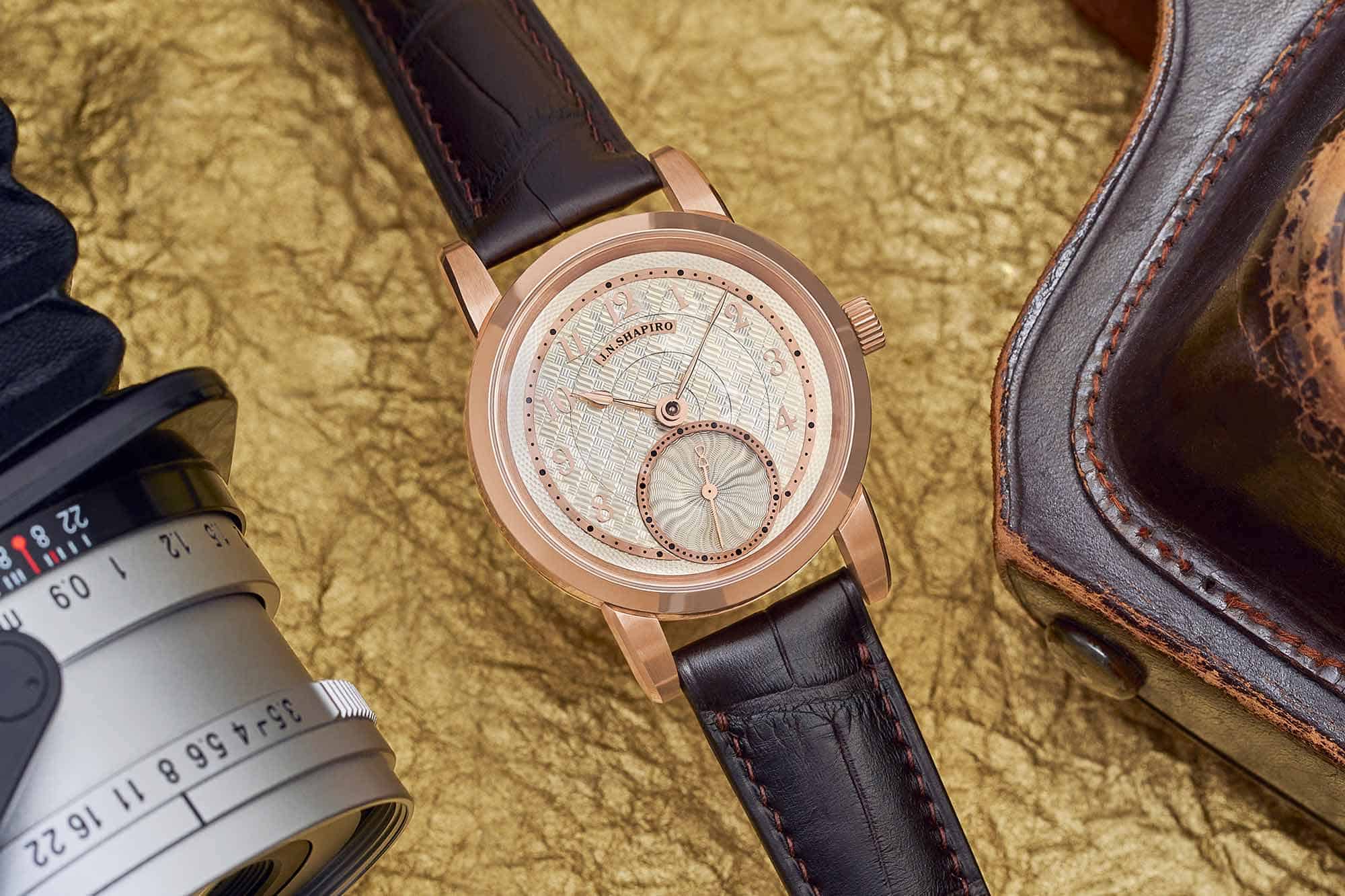
J.N. Shapiro Resurgence
What prompted the return to a more attainable category with the Infinity Series Pure? Do you feel as though you’ve accomplished that original mission with the Resurgence watches in a way?
Yeah, in a sense, but bringing back an entry level watch was more about giving the people what they want. To do everything we wanted to do with the Resurgence line, we had to charge a lot of money. There was just no way to make that watch any more affordable and honestly, we don’t charge enough for those. Not by far. Watchmaking in a vacuum is exceptionally difficult and it’s why we don’t see giant American mechanical watch brands.
We’re severely lacking in people here. Even Switzerland is understaffed in the watchmaking space right now – which is why they have to go to China for so many of their parts. Japan and China have huge watch labor forces. Germany relies on Switzerland, but in the United States, we have very few people in the profession and most of the watchmakers in the United States are employed in service, which is a very different skill from watch manufacturing. So that makes what we do a massive challenge just from a basic manufacturing infrastructure stand point.
It’s a small world of independents and we don’t really feel the heat in terms of competition. Most watch collectors that love independent watchmakers collect all of our watches.
We also make all the small parts that people don’t notice inside the watch. The pins, the winding pinion setting, the pinion balance, staff balance, the wheel-setting mechanism – all these small parts that go unnoticed in a movement because they aren’t beautiful bridges and plates that you see the second you open a caseback. These unnoticed parts are the most challenging to make and haven’t been made in this country in 70 years, so we’re having to relearn all the secrets and techniques and metallurgy behind making these tiny parts. The Infinity Series Pure is really a return to a very pure expression of what we do. We’re outsourcing the movement for these so the watch’s big focus can be the dial, which is really my calling card.

What’s the benefit of making a part that’s buried in the movement in-house? Is there a tangible quality differential in how that movement performs?
Well, one thing is that when most brands say “in-house,” it’s just a marketing term. They usually mean it’s a proprietary movement and they send it out to a million different subcontractors. I was always really inspired by George Daniels and Roger Smith, who really do everything under one roof. To make something truly in-house was always my dream and was always my goal. I was inspired by the challenge of doing that. So that’s one aspect of it.
The other aspect is that, in order to kickstart American watchmaking, we had to bite the bullet and do all of the hard things. People in this country have made main plates and bridges before, but no one has gone back to do what Hamilton and Waltham and Elgin were doing – which is making virtually everything in a watch. There’s only one way to kickstart that kind of manufacturing revolution and that’s just to do it. And yes, there’s a pragmatic element here in that we have ultimate quality control. We’re not waiting on suppliers or relying on them for that. If there’s an issue with a part or we discover a better way of doing things, we can implement it immediately.
Garrick’s David Brailsford comes from the same kind of Daniels school of design and watchmaking. You guys have a lot of parallels in your extreme sense of pride in bringing high-level watchmaking back to your countries and doing it the hard way. Do you interact with guys like David much? I’m curious what the social side of your niche is like.
I’ve talked to most people in the independent world at this point. Whether it’s Max Büsser or Garrick. It’s a small world of independents and we don’t really feel the heat in terms of competition. Most watch collectors that love independent watchmakers collect all of our watches. The real competition is the major Swiss brands; if we took 1% of what Rolex and Swatch and Richemont are doing, all of the independent watch brands would be fantastically wealthy.
Is there much knowledge shared between the independents? How do you learn these lost techniques without a direct mouth-to-ear apprenticeship situation?
I definitely have groups of watchmaker friends that I know and trust and it’s a very mutual exchange. Everyone is at a different level and we’re in this Alternative Horological Alliance together. Brands like Ming and Fleming. We’re all passionate people and passionate about watchmaking. I have other friends that are in the watchmaking sphere that I only talk manufacturing things with, so we do trade and exchange knowledge, but there’s other people in this space that are not interested in doing that at all and have a very closed mindset. That’s understandable and I don’t blame them as there are techniques and designs that I’ve worked extremely hard on that I couldn’t even give to a close friend because I’ve invested millions of dollars into getting right and my business relies on it staying proprietary.

I do try to be as open and forthright as I can about many things that we’ve struggled to figure out. For example, when I figured out suppliers for hair-springs and jewels in the US, I shared it publicly for anyone’s benefit.
That keeps those companies in business, too.
What I’ve found is that both of those companies got into other industries, like the jewel company was originally founded by Bulova and the Defense Department. Eventually, Bulova went out of business and the Defense Department’s stockpile filled up, so this company pivoted to medical and aerospace. (Editor’s note: a stake in Bulova was acquired by Gulf and Western Industries in 1973, which was later sold to Stelux Manufacturing Company, a Hong Kong based manufacturer of watch components, in 1976.) I came begging for them to make jewels for watch movements again 60 years later and here we are.
Can you give me an example of a technique that you’ve had to learn without much direct guidance, where there was nothing out there to learn from other than trying to reverse engineer a vintage piece?
With guilloché, there’s no school for learning that, but you do have some books available. There are people in the US that do it as a hobby and a lot of people that do woodworking with the same machines. You’ve got George Daniels’ work to learn from, but you’re missing all the fine detail that makes or breaks it. You basically just have to get a machine and put in a lot of sweat through trial-and-error until you get it right, and then talking to as many people that were working on that themselves and trying to get nuggets of knowledge wherever I could. No one was doing exactly what I wanted to do with it, like the basket weave design. Only Roger Smith was doing something close with a true basket weave. The Swiss were doing guilloché with straight lines and some indexing, but it was something else really. Roger Smith had some videos on it and I talked to him a little bit and he was very open with his knowledge, which was really cool, but the rest was really just trial-and-error.
I knew if I wanted to make a splash and also do something meaningful, I needed to take it to the next level and that was where the infinity weave came in. I wanted to make something much more challenging and create something that’s like a treat for macro photography.
In order to make these watches fully in the US, we had to rediscover and relearn a really complex process and do it the hard way. It’s an integral part of what we do as a brand.
On the less glamorous side, something that’s boring, but very secretive and maybe the most important thing in watchmaking is heat-treating steel components. A watch can’t run without steel components and steel needs to be soft for machining, but needs to be hardened and tempered to be functional in the watch. There’s a lot of techniques that describe it, but they usually describe the process for one-offs and repairs. We needed to make these parts at an industrial level, so lots of parts with a very repeatable process and we had to learn the right way to heat-treat, harden, and temper those parts at an industrial scale from scratch. There are companies in the US that do those processes all day long with steel, but they looked at the size of our parts and said “Good luck, you can forget it.” All of them had massive ovens for large parts, and we found one company that had a smaller oven and we spent all sorts of money and time trying to work with them in the US and when it came down to it, the parts came out awful.

We were forced to bring it in-house. One of my employees has a master’s in material science engineering and he just went for it and spent months on it. If I wanted to go to Switzerland for it, there’s one company that does it for everyone. Literally from the biggest brands to the smallest independents, and they have the system down and have had an unbroken tradition of heat-treating watch parts that goes back to the 19th century. The Swiss never lost their knowledge or skills because it was continuous. In order to make these watches fully in the US, we had to rediscover and relearn a really complex process and do it the hard way. It’s an integral part of what we do as a brand.
The infinity weave dial is really the Shapiro signature riff, something that can be a hard thing to create with watches that come from such a traditional place aesthetically. Where else do you find places to express your personality and sense of style as a watchmaker through your watches?
Our font is a big one and we have a unique twist on Breguet numerals we developed. I really love that font and we use it in all our watches now and I consider it a big signature. For the Infinity Series, we have our skeletonized Breguet hands; almost no one makes hands that way because manufacturing and finishing them is extremely difficult, but the result is a beautiful, three-dimensional handset with a very open tip. And even getting the tip of that triangle to come to as much of a peak as possible requires using like the world’s smallest cutters. There’s more that goes into some of these visual touches than most people realize.
We’re releasing two different models in the Infinity Series, actually. One is very traditional with a white dial, silver chapter ring, and rose gold accents, and the other one has a dial made out of zirconium. I’ve really enjoyed exploring new and exotic materials with the Infinity Series and am continuing to do that with the Resurgence line. Using this traditional aesthetic, but with exotic materials is something unique and I believe our doing so has actually had a big influence on other independents. We forged that path and I see a lot of other brands taking a traditional format and bringing in exotic materials.

How did you land on zirconium as a watchmaking material?
Zirconium is used in knife making quite a bit. Usually to get a dark color on metal, you have to plate it or paint it. Plating on top of guilloche is very risky; if the plating goes bad, then the entire dial is ruined and we had that happen quite often, especially when going for dark colors. Painting always mutes the guilloché a little bit and you always lose some of that intricacy when you paint over it. Zirconium is almost as light as titanium and engraves nicely. You don’t lose any of the definition of the guilloché and I’ve never had an issue with it failing. When you take a torch to it and heat it until it’s red, it takes on this beautiful black oxide layer when it cools. It’s dark, but allows the brightness of the guilloché to shine through and it’s very tough, so you can actually use it in a watch’s case as well. It’s not scratch resistant, but it’s as hard as any PVD coating is. I’m in love with that material and that process and we’ve been using it on the Resurgence watches and will now be using it in the Infinity series.
Returning to the Infinity Series Pure, it’s more of a rebirth and refinement than a wholly new watch. For the outsider that may be new to Shapiro or watches made by independents in general, what goes into a $26,000 watch that’s still considered “entry level?”
The amount of time and effort it takes to hone the skills that go into that dial and the caseback. No one else in the world has the skills that go into making the specific guilloché on that dial and that has taken me 14 years of continuous refinement to do the way I do it. And it’s really me doing that on your watch. I’m still paying the taxes, doing the accounting, taking out the trash, and looking after 15 employees and sitting down and doing the guilloche on these dials. Collectors are getting my lifeforce in that dial; it’s hours and hours of time to make their actual dial and it’s years and years of practice to learn how to do it the way I do. It’s a multi-layer dial, not just a flat dial that’s been pad printed on. The chapter ring is a separate piece held together with the tiniest screws that you can’t see because they’re covered with ink. Same with the second ring. Those are all separate pieces worked on individually. We then spend hours upon hours machining and finishing the hands, and you won’t find hands like that anywhere near this price point.

I feel that the dial is a canvas and it’s got a lot of human time spent on it. It becomes a piece of art in that sense and you’re not paying for marketing, you’re not paying for luxury in the instantly recognized status symbol sense, you’re paying for my lifeforce instead of a marketing budget to have an advertisement with a movie star in it.
On a grander scale and looking into the future, do you feel any obligation or responsibility to see American watchmaking grow as a byproduct of what you’re doing? And what’s the long term dream for J.N. Shapiro?
“Handmade” gets thrown around a lot these days and it almost means nothing. There’s hand-finishing techniques, and then there’s making parts manually, and there’s making parts automatically. Even before computers, parts were made in the millions automatically with cam-driven machines. Now we use CNC machines, but I’m always seeking a balance between what we can do by hand and what we do automatically. We have CNC machines because any company that wants to make more than one watch a year has to have automatic machinery. Otherwise, you’re George Daniels and it takes thousands of hours to make one timepiece.

When you look at a part like a balance staff, it’s such a tiny component, but it’s extremely important and we were hand-turning those parts until recently. It could take over an hour to make one and it was extremely frustrating because we’d break a lot of their pivots while hand-polishing them. Those pivots are the size of a human hair, so this part had one of our highest breakage rates.
After months of research and development on one of our automatic lathes – which was made by Citizen by the way – we figured out how to make a balance staff automatically, and we can make about one a minute. We still have to finish them by hand and there’s still all the heat treating processes and we have to do to these parts, but just taking it down from an hour to a minute is tremendous for us. It’s the first time these parts have been made automatically in around 70 years and that’s taking a major step in bringing this industry back to the US on a larger scale.
How would you describe the archetypical Shapiro client?
It’s often someone that got into Rolex then discovered Patek, and then went down the independent rabbit hole from there. Someone introduced them to Journe typically and they expanded into the independent world from there. Many of them are entrepreneurs and more on the adventurous side. I’ve found most of my customers have worked hard for their money and I think our brand resonates with them because we do things the hard way, too. The independent spirit tends to really resonate with them. I really love my customers and I really enjoy working with them.

What’s in your watch box that might surprise Shapiro fans?
I like vintage stuff in general. I have a vintage Omega Seamaster with the 321 movement that I love. I collect a lot of my friends’ watches as much as I can and one of my good friends is Nick Harris, who owns Orion watches and I have one of his watches. I have a Universal Geneve Polerouter that I got years ago and love. I also collect American pocket watches, and a very obscure brand called Touchon that was making incredible pocket watches at arguably a higher level than Patek in the 1920s. But yeah, my collection is all over the place.
Do you have something that you’ve made for yourself that’s unobtainium for Shapiro clients?
We still have the prototype for the Resurgence, but I rarely wear my own watches and I don’t own one of my own watches either. I’m all-in on the company, so what I really want to do is create watches for my employees. All the watchmakers and people that work here that are putting so much time and sweat into their work are really my first priority, so trying to get them all watches to wear is more important to me than having one of my own. But yeah, every cent goes back into the company; I used to be a teacher and a principal and I’d use the money for that to feed my family and anything I made from watchmaking would just go back into the business. I’m still very much into that mindset. J.N. Shapiro
The post Craft, Precision, and the Future of American Watchmaking: an Interview with Josh Shapiro appeared first on Worn & Wound.


Comments
Post a Comment